Coordinated Omission: Why Your Latency Numbers Lie
Most HTTP benchmarking tools quietly hide tail latency when the server slows down. The phenomenon is called coordinated omission, it shows up almost exclusively in p99 and beyond, and it has caused production incidents at organisations that thought their load tests were green. This post explains the mechanism, demonstrates it empirically with a reproducible benchmark of eight tools across a healthy control and four server pathologies, and shows how to fix it with a constant arrival-rate workload model. The load test passed. p99 was 47 ms. In production, the same release showed p99 of 1.8 seconds — a 38× regression that the test had reported as nothing. Nothing was wrong with production. Everything was wrong with how we measured. This article is about a single, specific failure mode in load testing — one that is well known to a small number of practitioners and almost completely invisible to everyone else. It is called coordinated omission, the term was coined by Gil Tene in the early 2010s, and it explains why a benchmarking tool that works perfectly under healthy conditions can become catastrophically optimistic the moment the system under test starts to struggle. If you write or interpret load tests, this is the kind of phenomenon you want to internalise once and never have to re-learn. To make the demonstration concrete rather than rhetorical, the post is backed by a companion repository that runs eight load tools against four reproducible server pathologies plus a healthy control. Every plot below is generated from real measurements; the numbers are reproducible on any modern laptop in under five minutes per scenario. Most HTTP benchmarking tools — When the server is healthy, this loop is fine. Each iteration takes a few milliseconds, requests stream out at a steady rate, and the reported latencies match what real users would have experienced. The problem is what happens when the server slows down. Suppose, midway through a five-minute test, the server experiences a 1-second hiccup — a long garbage collection pause, a cache miss, a brief network blip. During that second, every virtual user in the loop is blocked waiting for its response. No new requests are sent. When the server recovers, the virtual users record one slightly slow response each (around 1 second), then resume the normal rhythm. The reported latency distribution will contain those one-per-VU slow responses. What it will not contain is the swarm of requests that real production traffic would have sent during the slowdown — and that real users would have observed waiting for far more than 1 second each, because they would have been queued behind the recovering server. The benchmarking tool has, in effect, coordinated with the server: when the server stopped responding, the tool stopped sending. The tool has omitted the requests that would have demonstrated how bad the slowdown actually was. Hence the name. This is not a bug in any single tool. It is a structural consequence of the closed-loop request model — what queueing theorists call a closed workload model. The companion repository ships a deliberately misbehaving Go HTTP server, nine load-tool runners, and an analysis pipeline that turns raw HDR/CSV outputs into the SVG plots used here. Five scenarios isolate distinct server pathologies; the same eight tools probe each one. Every measurement in this article comes from this suite. The shared profile across all scenarios is identical: The five scenarios add a different pathology on top of that baseline: The control scenario is the falsification test. If the eight tools disagree in scenarios 02–05 but agree in scenario 01, the divergence cannot be a property of the tools. It has to be a property of the phenomenon being measured. Scenario 02 reproduces the textbook situation. A single 1-second pause is scheduled at t=30 s — modelling a stop-the-world GC pause as observed from the client. All eight load tools run the same 60-second / 1 000 rps profile against the same server. The result, plotted as a percentile spectrum: The same effect, viewed as a timeline of individual response latencies: This is the empirical illustration of the article’s central claim, in two pictures. Average latency is mostly immune to coordinated omission. By definition, slow requests are rare events; the omitted ones do not move the mean meaningfully. In scenario 02, the average reported by The trouble lives in the tail. In the same scenario: The reported tail at p99 is between one and two orders of magnitude better than reality — and the gap does not close at p99.9; it widens, because the closed loop only ever records one stalled sample per virtual user, far too few to register at any percentile a dashboard watches. Reconvergence happens only at p99.99, where the handful of stalled samples finally outnumber the percentile’s population. And it is the tail that production users care about: at scale, p99 of 420 ms means that 1 % of all requests — possibly tens of thousands of users per minute — see an unusable system. p99 of 19 ms tells the dashboard nobody is suffering. Coordinated omission systematically hides the failure modes that matter most for user experience. The structural fix is to drive load at a fixed arrival rate rather than at a rate determined by the server’s responsiveness. This is the open workload model: requests are scheduled to start at predetermined times, and they are issued at those times whether or not the previous requests have completed. When the server slows down, the requests pile up — exactly as they would in production traffic from a large user base. Tools get there by one of two distinct mechanisms. Tools like Vegeta actually issue every request at its scheduled time (one lightweight task per request), so the queueing happens for real on the server side and lands in the measured latency naturally. Tools like wrk2, which issue from a bounded connection pool and can fall behind schedule, apply the intended-start-time correction instead: latency is computed from when the request should have started, not from when it actually started. Both roads lead to the same honest number. A tool that does neither — issuing late and timing from the actual start — re-creates the omission. Three tools were designed from the outset around this principle: A fourth tool worth noting: k6 offers a The same load profile, written two ways: The two scripts produce the following side-by-side under scenario 02: A k6 footgun worth knowing. The The full eight-tool spectrum on scenario 02: The published behaviour, summarised as a reference table: Scenario 02 is the textbook case. Real production pathologies rarely come as a single isolated 1-second stall; they come as recurring sub-second pauses, gradual ramps, or capacity walls. The companion repository ships three additional scenarios specifically because the lesson “closed-loop tools always lie” is too simple to survive contact with reality. In scenario 03 the server’s baseline latency ramps linearly from 10 ms to 100 ms between t=20 s and t=50 s, then stays at 100 ms. There is no discrete event — only a regime change. The observed percentile spectrum: The takeaway is intellectually important: closed-loop tools do not always lie. They lie about hiccups. They reflect sustained regimes — but with a different bias (over- or under-stating the median depending on whether the run is iteration-counted or duration-bounded). The phenomenon to watch for is the event, not the level. Scenario 04 holds the gate for 200 ms every 10 s — six pauses across a 60-second test. Each pause is an order of magnitude shorter than scenario 02’s, but the recurrence accumulates: This is closer to a realistic GC-induced pause profile than the dramatic 1-second stall of scenario 02. The lesson generalises: coordinated omission is not limited to spectacular hiccups. It quietly hides any recurring sub-second pause, with the lie resolving only deeper in the tail. Scenario 05 enforces a maximum number of concurrent in-flight requests at the server. With a non-binding cap, all eight tools agree across the spectrum (the boring case — useful precisely because it shows that a generous capacity ceiling does not, by itself, perturb the measurement): Pushing the cap below The open-loop measurement of a saturated system is not honest about latency in any meaningful sense — it is dominated by the timeout policy, not by the system under test. This is the limit case of constant-arrival-rate measurement: when the load is impossible, the measurement reflects how the tool handles impossibility, not how the system performs. The story above might suggest that the open workload model is universally correct and the closed loop is always wrong. That is not quite right. The two models correspond to two genuinely different real-world situations: Most real systems serve open workloads. Most benchmarking defaults assume closed. That mismatch is the root of the problem. The discipline is not to abolish closed-loop benchmarks — it is to use the right model for the system you are testing. When in doubt about your real production traffic shape, the open model is the safer default. A test that overstates queueing during a slowdown produces conservative results; a test that understates it produces dangerous ones. Four things: Coordinated omission is the kind of phenomenon that, once you know it exists, you start seeing everywhere. The wrk number that disagreed with the production trace; the green pre-release benchmark followed by the page-out at 14:30; the “p99 was fine in staging” post-mortem note. None of these necessarily were coordinated omission. But all of them have it as a candidate cause. The reproducible suite that backs this article is on github.com/be-next/Coordinated-Omission. Cloning it and running The references below are also collected in this site’s library of foundational works, under Landmark talks. Tene, G. How NOT to Measure Latency [Conference talk]. YouTube. — The definitive treatment, by the originator of the term. Required viewing once in a career. Tene, G. HdrHistogram — A High Dynamic Range Histogram. hdrhistogram.org. — The data-structure work that makes honest tail-latency recording tractable at scale. Schroeder, B., Wierman, A., & Harchol-Balter, M. (2006). Open versus closed: A cautionary tale. Proceedings of the 3rd USENIX Symposium on Networked Systems Design and Implementation (NSDI). — The reference paper on the open-versus-closed workload distinction. Pre-dates the coordinated omission terminology but states the underlying queueing-theoretic case clearly. Grafana k6 Documentation. Open and closed models. grafana.com/docs/k6/latest/using-k6/scenarios/concepts/open-vs-closed/. — Practical reference for choosing an executor with the right workload semantics. Ramette, J. Coordinated-Omission — companion repository [Code & data]. github.com/be-next/Coordinated-Omission. — Reproducible material for this article: a deliberately misbehaving Go HTTP server, eight load-tool runners, five scenarios, and the analysis pipeline that generates every plot above. The benchmark loop
ab, wrk, hey, the default scenarios in JMeter and Gatling, naïve scripts in any language — operate on a simple synchronous loop:for each virtual user:
while test is running:
t_start = now()
send_request()
wait_for_response()
t_end = now()
record(t_end - t_start) What coordinated omission is
A reproducible experiment
Parameter Value Test duration 60 s Target rate 1 000 rps Baseline latency 10 ms Scenario Pathology What it shows 01-healthy none (control) All eight tools agree when nothing is wrong 02-single-hiccup one 1-second stall at t=30 s The canonical case — closed-loop hides the stall at p99 03-sustained-slowdown linear ramp 10 ms → 100 ms over 30 s Coordinated omission fades under regime change 04-gc-pauses 200 ms stall every 10 s (× 6) More realistic than 02; the lie shifts deeper into the tail 05-saturation concurrency cap that may or may not bind Open-loop measurement collapses into timeout-dominated noise 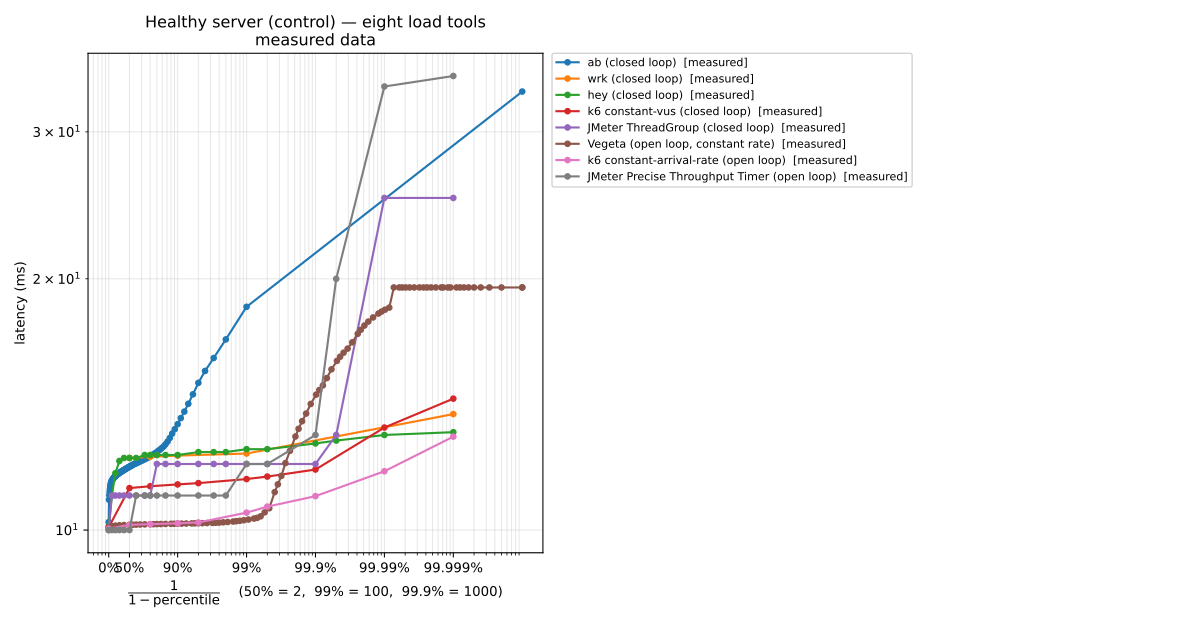 Scenario 01 (control). Every percentile from p50 to p99.99 lands within ~30 ms across all eight tools. There is no closed-loop / open-loop split. Whatever divergence the next scenarios produce is real, not instrumental.
 The canonical case: a 1-second hiccup
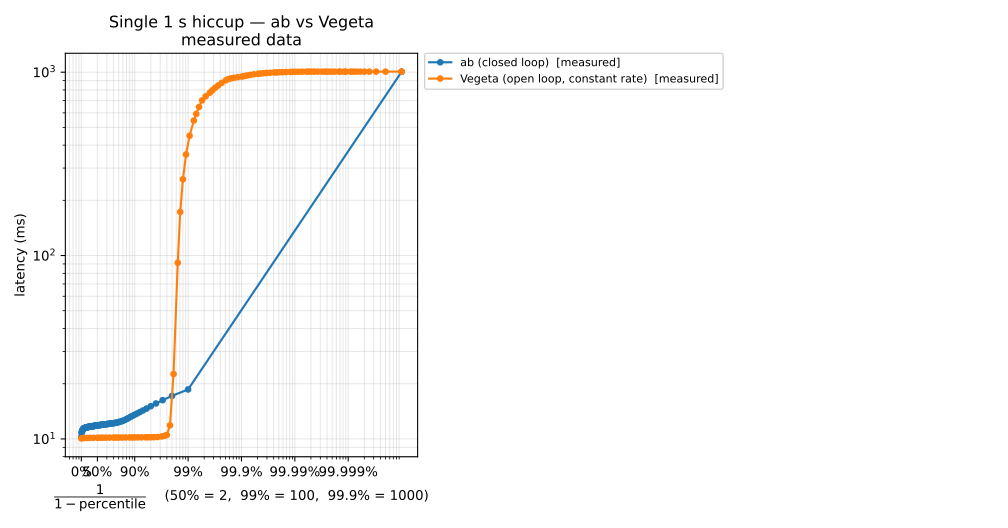 Scenario 02 —
 ab (closed loop) vs Vegeta (open loop, constant rate). The two curves agree from p50 to p95, then diverge by ~22× at p99 (~19 ms vs ~417 ms). The gap keeps widening at p99.9 (~27 ms vs ~954 ms — the closed loop records too few stalled samples to lift even this percentile); the curves reconverge only at p99.99, where the 1-second stall can no longer stay hidden.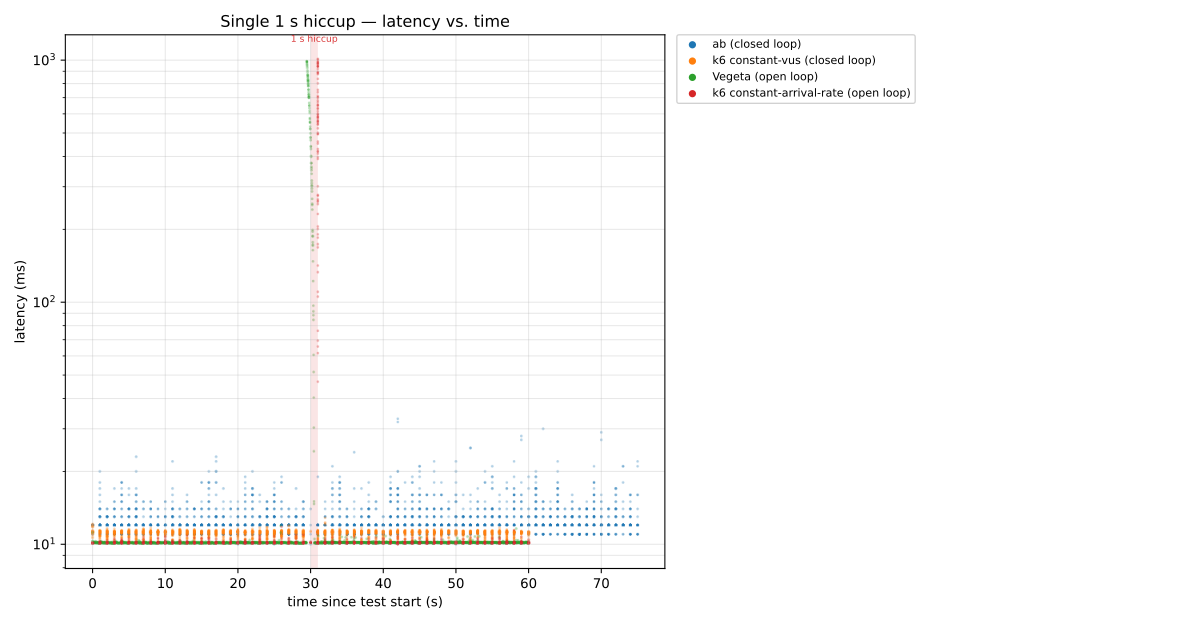 Scenario 02 timeline. The shaded band is the 1-second hiccup window.
 ab (top, closed-loop) records about ten stalled samples — one per virtual user that happened to be in flight when the gate closed. Vegeta (bottom, open-loop) records the full queueing wedge of ~1 000 requests that arrived during the stall and unblocked together when it ended. The two tools were instrumented identically; they are looking at the same server. They are measuring different things. Why tail latency takes the biggest hit
ab is 12.4 ms; the average reported by Vegeta is 18.6 ms. The closed-loop number is barely 6 ms off — close enough to look fine on a dashboard.Percentile closed-loop tools open-loop tools factor p50 ~10–12 ms ~10 ms 1× p95 ~12–15 ms ~10 ms 1.5× p99 ~12–19 ms ~410–420 ms ~22–36× p99.9 ~12–27 ms ~950 ms ~35–80× p99.99 ~1 000 ms ~1 000 ms 1× The fix: constant arrival rate
wrk. Adds a constant rate flag (-R) and uses HdrHistogram internally for high-fidelity recording.-rate) and excellent reporting.constant-arrival-rate executor that, when used correctly, also avoids coordinated omission. The default executors (shared-iterations, constant-vus) do not. A worked example in k6
// ❌ BAD — closed loop. Susceptible to coordinated omission.
// The 50 VUs each loop as fast as the server allows.
// If the server slows down, the loop slows down, requests are not sent.
export const options = {
  scenarios: {
    susceptible: {
      executor: 'constant-vus',
      vus: 50,
      duration: '1m',
    },
  },
};

export default function () {
  http.get('http://127.0.0.1:8080/api');
}
// ✅ GOOD — constant arrival rate. Coordinated-omission-aware.
// k6 schedules 1 000 requests/sec regardless of response time.
// Slow responses pile up and contribute to honest tail-latency numbers.
export const options = {
scenarios: {
honest: {
executor: 'constant-arrival-rate',
rate: 1000,
timeUnit: '1s',
duration: '1m',
preAllocatedVUs: 1500,
maxVUs: 5000, // headroom for slow-response queuing
},
},
};
export default function () {
http.get('http://127.0.0.1:8080/api');
}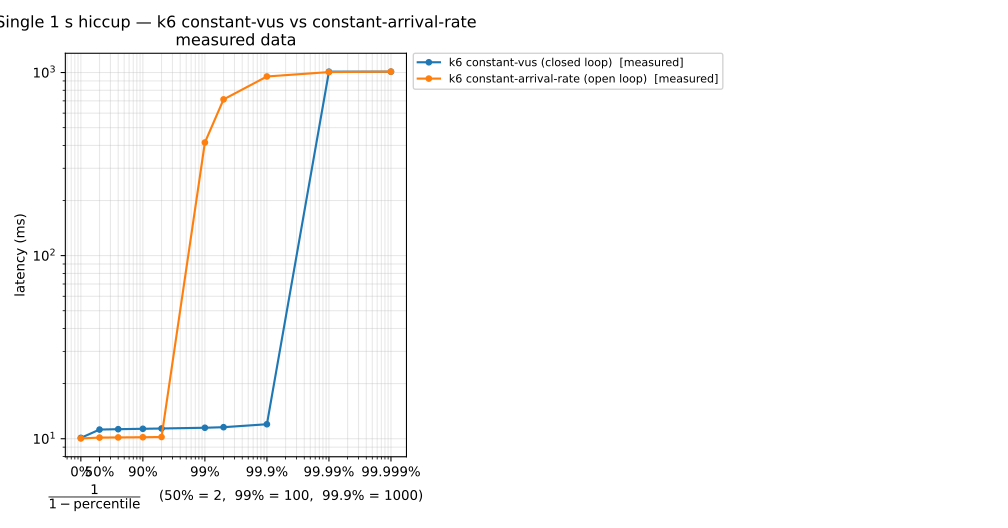 Scenario 02 — k6 in both modes.
 constant-vus is the closed-loop tracking curve; constant-arrival-rate is the open-loop tracking curve. Same tool, same target server, same load profile. The choice of executor changes the reported p99 by a factor of ~36.constant-arrival-rate executor is only honest if preAllocatedVUs and maxVUs are large enough to absorb the slow-down peak. If the pool saturates, k6 reports dropped_iterations and silently omits the queued requests — partially reintroducing coordinated omission while advertising an open-loop model. The configuration above pre-allocates 1 500 VUs with a ceiling of 5 000 to be safe at 1 000 rps across a 1-second stall (where the queue can reach ~1 000 simultaneously waiting requests). The companion repository’s k6-good runner uses these exact values; reduce them at your peril. Tools at a glance
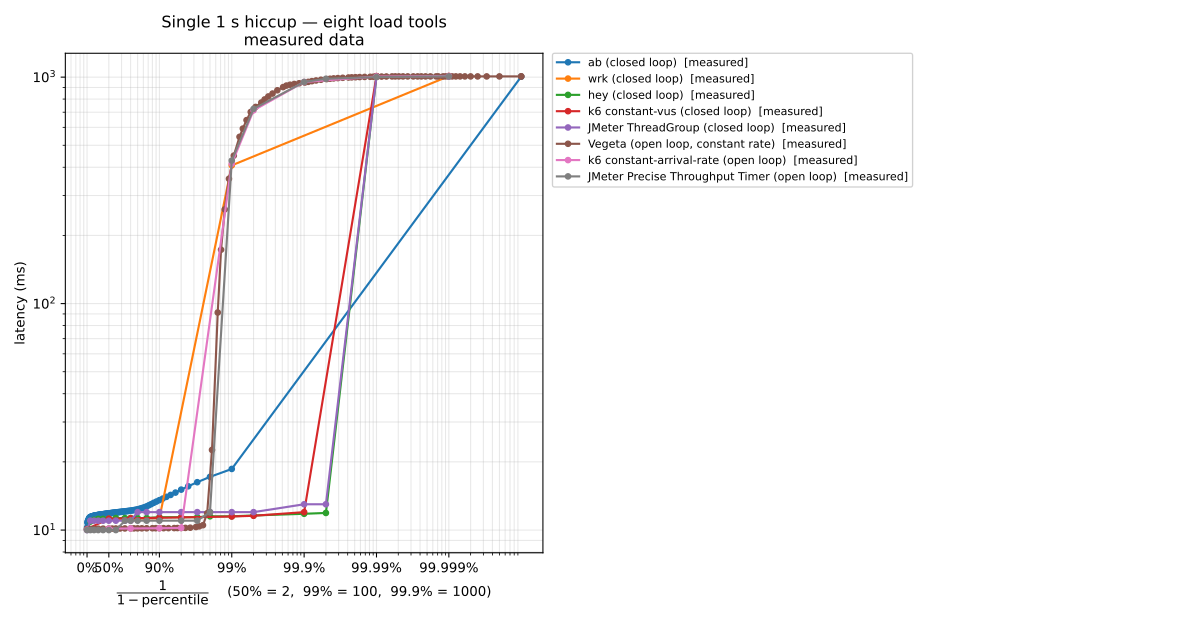 Scenario 02 — eight tools on one plot. The closed-loop cluster (
ab, hey, k6 constant-vus, JMeter ThreadGroup) hugs the baseline through p99. The open-loop cluster (Vegeta, k6 constant-arrival-rate, JMeter Precise Throughput Timer) climbs to the queueing wedge from p95 onward. wrk sits between the two — see the caveat below.Tool Default model CO-aware? Notes ab (Apache Bench) Closed loop ❌ Fine for sanity checks, misleading for tail latency wrk Closed loop ⚠ borderline Conventionally closed-loop, but its --latency HDR output reports a tail much closer to the open-loop tools (~408 ms p99 in scenario 02). The most plausible explanation is that wrk’s internal timestamping is closer to intended start time than its peers. Treat as borderline, not a clean negative example.wrk2 Open (constant rate) ✅ Gil Tene’s fix; HdrHistogram-backed. Does not build on Apple Silicon out of the box (LuaJIT vendored in giltene/wrk2 predates arm64) — which is why it is absent from the eight-tool plots above; the companion repository ships its runner for platforms where it builds.hey Closed loop ❌ Convenient CLI, same caveat as abVegeta Open (constant rate) ✅ Clean Go library, good reporting Hyperfoil Open by design ✅ Distributed, built explicitly around honest measurement JMeter ThreadGroup Closed loop (default) ❌ Default — susceptible JMeter Precise Throughput Timer Open ✅ Configurable; honest when used correctly k6 constant-vusClosed loop ❌ Default executor — susceptible k6 constant-arrival-rateOpen ✅ Honest when preAllocatedVUs / maxVUs are sized to absorb the peak (see footgun above)Locust Closed loop ❌ Open-rate work in the community, not first-class Beyond the single hiccup
Sustained slowdown: when closed-loop stops lying
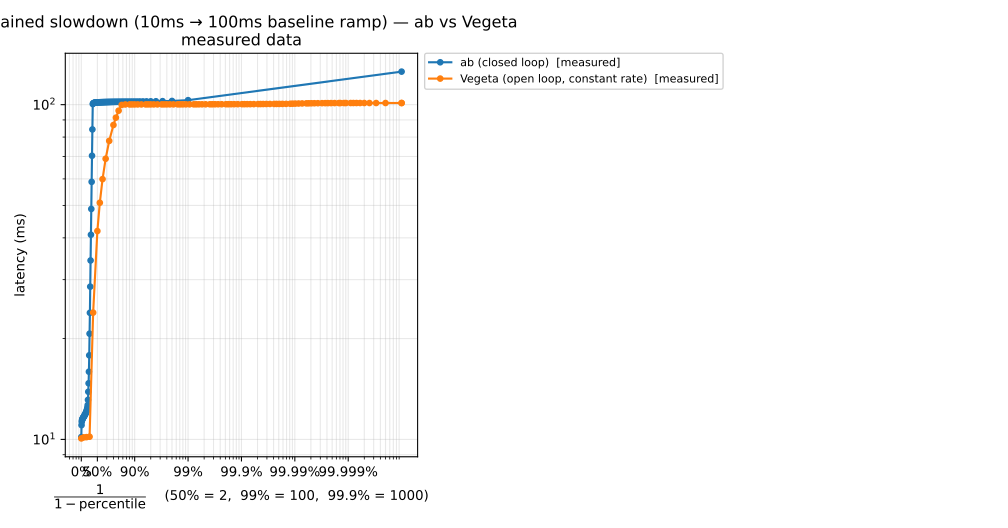 Scenario 03 (sustained slowdown). At p99 both
 ab and Vegeta land near 100 ms — the new plateau. The split has migrated into the body of the distribution: ab reports p50 ≈ 100 ms (its run is iteration-counted, so it stays on the wire long enough that the slow late part dominates), Vegeta reports p50 ≈ 42 ms (the fast early part is sampled at the same rate as the slow late part). Recurring pauses: closer to real production
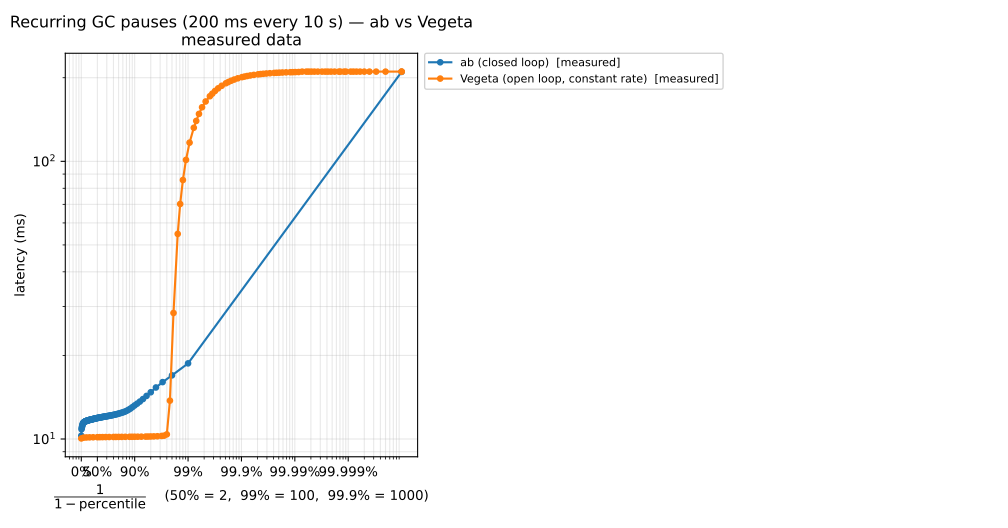 Scenario 04 (recurring pauses). With 6 × 200 ms × 1 000 rps = ~1 200 affected requests out of 60 000 (= 2 %), the divergence shows up cleanly between p98 and p99.9. At p99 the closed-loop tools still report ~12–19 ms; open-loop tools report ~115 ms (about half the pause duration on average). At p99.9 every tool finally surfaces the 200 ms plateau.
 Saturation: when open-loop also breaks down
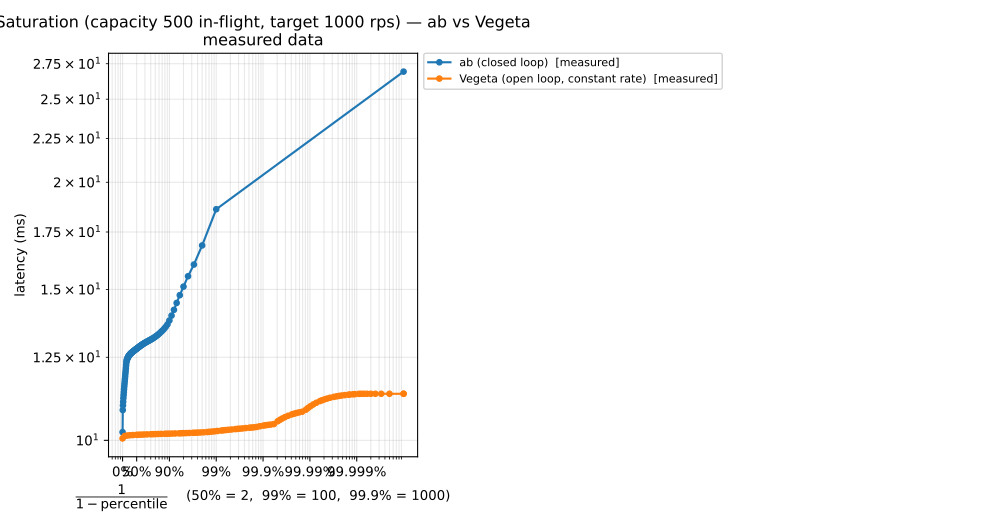 Scenario 05 (non-binding cap). When the server has headroom, every tool reports the same answer. The
 wrk slope at the extreme tail is the tool’s well-known low-rate sample-collection artefact, not coordinated omission.target_rate × baseline_latency — for example -max-concurrency 5 against a target of 1 000 rps — saturates the system. Closed-loop tools rate-down to whatever the cap allows (~500 rps in this case) and report healthy latencies. Open-loop tools refuse to slow down, accumulate a queue that grows by ~500 rps each second, and report runaway tail latency until they hit their request timeout. Caveats: when a closed loop is actually correct
What to take away
dropped_iterations footgun and the saturation regime show that open-loop is not a free pass — it is honest only when the tool has the headroom to absorb the queue and the run is not capacity-bound.make scenario-02 takes about three minutes and produces the same plots shown above, on your hardware, against your installed tools. If the article changes how you read your next benchmark, the experiment is the proof. Further reading